Explanation:
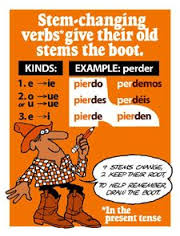
In all three conjugations of verbs the ar, er, and ir there are some verbs whose vowels change in the middle. These types of verbs are called stem-changers. They occur in all pronouns except nosotros and vosotros (which you do not need to know if you don’t live in spain). These two pronoun views maintain the regular stem. There are six varieties of stem-change. For example;
o changes to ue e goes to ie e to i i to ie u to ue
One of the main reasons for the use of stem changing verbs is because the sound of the word. In order to make a verb/word easier to say, they altered the middle of it. Also they do this in order to make words not sound like, or look like another words. Although stem changing verbs do not exist in the english language something that is similar to this is how 2 or more letters together can make a different sound than what it would normally make if they were separated. For example the way that TYP changes its sound in order to be easier to say. Such as the word TYPE and the word TYPICAL. Another example is the words CHURCH and CHRISTMAS. Some examples in spanish are; instead of saying podo, you say puedo.
HISTORY
Among the -ar and -er verbs, the modern e ~ ie and o ~ue alternations that are exhibited in the present tense directly reflect (in principle at least) the diphthongization of Vulgar Latin. The latter sounds, because they occurred only in stressed syllables, appeared as root vowels only in the rhizotonic forms of the paradigm. This situation is reflected in modern Spanish in the fact that the diphthongs ie and ue occur in the rhizotonic forms of the present tense, whereas the corresponding monophthongs e and o occur in the forms in which the stress falls on the ending. This is illustrated below:
The root vocalism of -ir verbs has a rather more complex history than that of the -ar and -er verbs. Here the crucial factor was metaphony, induced by the root increment j that was present at various points in the relevant verbal paradigms. This j was the reflex of an earlier full vowel, either i or e, which semi vocalized following the generalized loss of the hiatus.
Spanish is ultimately a derivative of Latin. Classical Latin as we know it is a rather artificial, formal, and archaic version of what was actually spoken in the days of the Roman Empire. This kind of Latin ceased to be in colloquial use sometime around the second century BC, but its use in oration and especially writing has continued down to the present day. But the language spoken by the common man, and promulgated by the advancing Roman legions, was vulgar Latin (not so called because it used naughty words, but because it was spoken by the vulgus). As nearly always happens with living languages, the vulgar Latin diverged greatly over time from classical Latin, which remained essentially intact, and became a base corruption of its former self (though in truth, all natural languages are corruptions of their former selves).
http://www.university-world.com/spanish/spanish_history.html

The Linguistics of Spanish
https://www.staff.ncl.ac.uk/i.e.mackenzie/hisverb.ht


How to use stem changes
https://m.youtube.com/watch?v=sDaDoL9IYso
Real Life Examples
- “Yo quiero la pluma rojo.”
- “I want the red pen.”
- “Tú piensas la camisa costar quince euros.”
- “You think the shirt cost 15 euros.”
- “Shrek prefiere las manzanas.”
- “Shrek prefers apples.”
- “Carlos cierra la ventana.”
- “Carlos closed the window.”
- “Los estudiantes entienden mathematica y ciencias.”
- “The students understand math and science.”
- “Yo empiezo la examan.”
- “I began the test.”
- “Yo quiero ir de compras a el centro comercial para los jeans.”
- “I want to go shopping at the mall/ shopping center for jeans.”
- “Los estudiantes entienden números.”
- “The students understand numbers.”
- “Tu empiezas la carrera rapido.”
- “You begin the race fast.”

 Gard Spanish 2
I like that you put in some of your own pictures. I didn’t know there were different versions of Latin.
LikeLike
Using your own work was a great thing you guys used.
LikeLike
This one is the best one i love it so much
LikeLike
I also liked that you guys used your own work for the pictures, instead of getting a picture you can see in a google search, great job!
LikeLike
I liked the examples that were used, and I loved how your group included pictures of your own work!
LikeLike
I love all of the examples you guys added in and overall you guys did a great job!
LikeLike
The examples are helpful and the explanation helps teach the stuff to you
LikeLike
I really like how your guys took a picture your own work. I didn’t even think about doing that.
LikeLike
Showing your own work was a good idea. But also this explanation is interesting because putting it together with all of the other presentations on this page you can piece together that a lot of Spanish was made from Latin.
LikeLike
I liked that you guys put links to different thing so that people can go to different websites and get even more information by themselves.
LikeLike
I liked the examples and the pictures they were very creative!
LikeLike
The overall blog is VERY creative and understandable.I like how you put enough examples and information.
LikeLike
Good job taking a picture of your own work, i think that’s better than using a picture off the internet
LikeLike