
Ser vs. Estar
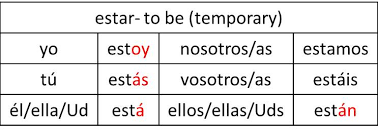
Ser and Estar both mean “to be”.They both mean “to be” but they have their own meanings.
To use estar,you need to indicate location,and say how people are feeling or feel. Estar is used to indicate location,and to describe temporary things. Estar can also be used with adjectives to tell/say how people feel at a given moment. Ex: Al lado(de)=next to
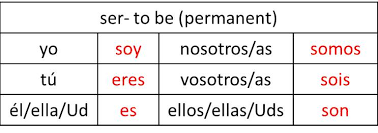
Ser means to be.Use ser to identify a person or say where he or she is from. Ex: Yo soy de Buenos Aires (I am from Buenos Aires.)
History
A copul is a word that links the subject of a sentence with a predicate.
The Spanish copulas are ser and estar:
stare → *estare → estar
The copula ser developed from two Latin verbs.
esse → èssere (as in Italian) → ésser (as in Catalan) → ser
sedere → *seder → seer → ser
Today ser is used to express the fundamental nature and identity or characteristics of something – what it really is, while estar expresses the state something happens to be in.
When To Use Ser and Estar
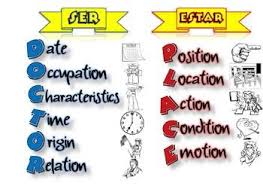
Use D.O.C.T.O.R. to find out when to use Ser (long term) Ser is used with:
- the hour, day, and date
- place of origin
- occupation
- nationality
- religious or political affiliation
- the material something is made of
- possession
- relationship of one person to another
- certain impersonal expressions
- where an event is taking place
- essential qualities
Use P.L.A.C.E. to find when to use Estar (short term) Estar is used with:
- geographic or physical location
- state or condition
- many idiomatic expressions
- progressive tenses
Examples
Ser:
¿Qué hora es? (time is permanent)
What time is it?
Son las dos. (time)
It’s two o’clock.
¿Qué día es hoy? (date is permanent)
What day is today?
Hoy es lunes. (date)
Today’s Monday.
Estar:
La manzana está verde.
The apple is green. (condition)
¿Dónde estás? (location is short term)
Where are you?
Estoy en el laboratorio. (location)
I’m in the laboratory.
¿Dónde está Chile? (location)
Where’s Chile?
Chile está en América del Sur. (location)
Chile is in South America.

 Gard Spanish 2
I think that you did a great job using the D.O.C.T.O.R. and P.L.A.C.E. graph, and I had no clue that ser developed from two Latin verbs
LikeLike
I like the Doctor and Place graph. It helped it make more sense.
LikeLike
Your use f the doctor and place acronyms helped my understanding of the different verb uses.
LikeLike
I like how this is not very long but it still has good information also it is very well spaced
LikeLike
I liked how you included the graphs and the acronyms to help remember ser and estar! I do think that a little more history could have been included.
LikeLike
I liked the acronyms you integrated in, it’s really helpful!
LikeLike
i learned that ser and estar are the copulas for the spanish language. something that I would have enjoyed seeing on your page is a video of some sort to explain the how to of these verbs.
LikeLike
i liked the chart it was really useful.
LikeLike
You guys did a great job explaining the difference between the two verbs, you made it so its easy to understand, great!
LikeLike
i love how you explained it, very clear and understandable, but you should have put more colorful pictures.
LikeLike
I like how you guys used a lot of examples. I also liked the layout of your page.
LikeLike
I liked the examples of doctor and place to find the right verb to use.
LikeLike