
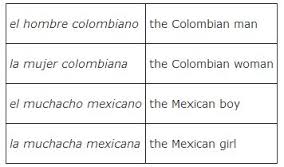
What are feminine and masculine in Spanish:
When speaking in Spanish every noun either ends in A(feminine) or O(masculine). Depending on the letter it will make the word masculine or feminine. But some words are feminine but end in an O and others are masculine but end in A. The reason behind this is the la(feminine) and the el(masculine) before the word.
History of masculine and feminine nouns in Spanish:
Why do gendered languages exist? After all, English does perfectly well without assigning “feminine” and “masculine” characteristics to objects that lack genitalia.
Actually, English used to be a gendered language, too. English speakers stopped classifying most nouns by gender during the Middle English period.
Basically, gender in languages is just one way of breaking up nouns into classes. In fact, according to some linguists, “grammatical gender” and “noun class” are the same thing. It’s an inheritance from our distant past. Researchers believe that Proto- Indo-European had two genders: animate and inanimate. It can also, in some cases, make it easier to use pronouns clearly when you’re talking about multiple objects.
The language known today as Spanish is derived from a dialect of spoken Latin that evolved in the north-central part of the Iberian Peninsula after the fall of the Western Roman Empire in the fifth century. A written standard was developed in the cities of Toledo (13th to 16th centuries) and Madrid (from the 1560s).
El is the singular, masculine definite article (the word for “the”), while la is the feminine version. But there is one instance where el is used with feminine nouns.
The substitution of el for la takes place only when it comes immediately before a singular noun that begins with a stressed a- or ha-. A few examples:
- el agua (the water)
- el ama de casa (the housewife)
- el asma (asthma)
- el arca (the ark)
- el hambre (hunger)
- el hampa (the underworld)
- el arpa (the harp)
- el águila (the eagle)
Spanish originated from the Iberian Peninsula. In the peninsula at the time they spoke latin, since some of Spanish came from latin it picked up masculine and feminine nouns along with other parts from other languages.
Real life examples–feminine and masculine Spanish verbs:
SOME NOUNS THAT REFER TO PROFESSIONS HAVE THE SAME FORM FOR MASCULINE AND FEMININE THE EL OR LA IS THE ONLY THING THAT CHANGES.
~ el piloto means the male pilot and la piloto means the female pilot.
~el soldado means the male soldier and la soldado means the female soldier.
WHEN SPEAKING ABOUT LIVING CREATURES THAT END IN O ARE MASCULINE AND NOUNS THAT END IN A ARE FEMININE.
~el oso means the male bear and la osa means the female bear
~los chicos means the boys and las chicas means the girls
“The only neuter (neither masculine nor feminine) nouns are abstract nouns, which are formed by preceding a descriptive adjective with the definite article lo. For example, you could say lo importante to form a neuter noun (or an adjective functioning as a noun) meaning ‘the important thing’ ” from spanish.about.com/od/nouns/a/nouns/.htm

 Gard Spanish 2
I think that you guys really did well with you’re lesson, I didn’t even know that English used to use masculine and feminine words.
LikeLike
I didn’t know that English used masculine and feminine nouns and that they stopped during the Middle English period
LikeLike
I didn’t know that english used to be a gendered language. I like that you put information about English as well to explain the Spanish origins.
LikeLike
I also didn’t know that English was a gendered language. I liked your information and i liked how you used real life examples.
LikeLike
I like your project. I learned that the Spanish language originated from the Iberian Peninsula. Something that they could have improved on is in the beginning they said that all verb endings will be based on and match their definite article.
LikeLike
Overall the page layout is easy to understand.This page really refreshed my information about masculine and feminine nouns.I also learned a lot of history about where the verbs came from. The examples helped me develop a better understanding on how to use it according to which verb is used in the sentence.
LikeLike
This page has furthered my understanding of masculine and feminine verbs. One thing I didn’t know was that some words are feminine but end in an O and others are masculine but end in A. Your real life examples really help others understand masculine and feminine verbs better.
LikeLike
This has good information and the history is very interesting and I had no idea that we used gender changing words in ennglish
LikeLike
I like your page. I did not know that Spanish originated from the Iberian peninsula. but i did not like the videos you posted. if you would have found a different video that explained it the same way but in a more entertaining way i would have really liked it.
LikeLike
I think it’s crazy that the english language had masculine and feminine words! I liked that you included more than one video and that you had an excellent amount of history!
LikeLike
i liked the history of the masculine and feminine nouns and it gave a good explanation of them too.
LikeLike
Wow I didn’t know that the English language used to contain masculine and feminine words. Anyway, overall you guys did a great job and I love the amount of history you added.
LikeLike
I really liked the idea that their is masculine and feminine words, I also liked that videos you guys chose!
LikeLike
I really like how your page is laid out. Its very easy to understand and I like how you have multiple tutorials.
LikeLike